Playbook · Marketing that works
Outdoor brands in 2027 need more content, and a way to see what it sells
Outdoor and cycling brand marketing strategy for 2027. Where YouTube, creators and brand search fit, how to pick markets, and what to measure.
The short version
- More content is the answer for outdoor brands, not less. Google is pushing more client budget into Demand Gen and YouTube, and those campaigns run on a steady supply of video.
- Join the channels into one funnel you can see, from existing customers at the bottom to people who have never heard of you at the top, and keep something running at the top all the time.
- Content on its own hits a ceiling. After that, paid creator collaborations, digital PR and affiliates take over, and knowing when to switch each one on is most of the skill.
- Don't pay for your own brand name in Google unless a competitor is bidding on it. For high-ticket kit, plant the reasons to buy over months and get creators to review it.
- Build locally before expanding, because delivery costs can wipe out the margin. Judge marketing on profit on ad spend and new incremental customers, and let the CRM team own repeat revenue.
What I mean by
- Demand Gen
- A Google Ads campaign type that shows image and video ads across YouTube, including Shorts, plus Discover and Gmail. It is built to find people before they search, using what Google knows about their interests and viewing, so it needs a steady supply of video and image content to work well.
- Full funnel
- Marketing that covers every stage between a stranger and a repeat customer, and can see each one. The top introduces the brand to new people, the middle turns interest into a reason to buy, and the bottom looks after existing customers. The point is visibility across all three, not activity in all three.
- Profit on ad spend (POAS)
- The profit an ad campaign brings in, divided by what the campaign cost. It differs from return on ad spend, which uses revenue, because it takes out the cost of the product, delivery and returns. A campaign can look healthy on revenue and still lose money once those costs come off.
- Incremental customer
- A customer who bought because of your marketing and would not have bought otherwise. Someone who searched your brand name and clicked an ad was probably coming anyway. Someone who had never heard of you until they watched a video and then bought is incremental, and that is the customer marketing should be judged on.
Most advice on outdoor brand marketing says the same thing. Stop making so much content, tell one core story and make it work harder across every channel. I agree with the second half. I don’t agree with the first. For an outdoor brand planning how to grow online in 2027, I think making more content is the most important thing it can do.
The reason is where Google is taking advertisers. Google is putting a lot of weight behind video. You can see it in how much client budget is being pushed towards Demand Gen. Those campaigns show ads across YouTube, including Shorts, and on Google’s other visual feeds. They don’t run on a few hero assets a year. They run on a steady supply of video and images, and the brands with more of it get more out of them.
So this playbook is about how to make more content pay. That means joining the channels into one funnel you can actually see. It means knowing when content stops being enough, and measuring the result on profit rather than revenue. I’ve worked with cycling and outdoor brands including Swiss Side and SWI, and this is how I’d approach it now.
Why do outdoor brands struggle to grow online?
There are three reasons, and they make each other worse. They apply just as much to cycling brands as to outdoor clothing and kit.
The first is that it’s a crowded place. Walkers, climbers, cyclists and runners all have more choice of kit than they’ve ever had, and most of it is sold online. Every product launch, seasonal sale and creator recommendation is competing for the same attention.
The second is that outdoor brands are often very technical, and they niche down. A brand starts with mountain jackets, then splits into alpine, trail running and fastpacking. Each of those is a smaller audience with its own language and its own reasons to buy. That’s good for the product. It’s harder for marketing, because every niche needs its own content to reach it.
Photo: BLM Oregon & Washington, public domain, via Wikimedia Commons.

The third is money. A handful of very big brands take up a large share of the advertising in this category. A smaller brand can’t outspend them on the same ads. It has to win on the content itself. That’s why I think content is pivotal for outdoor brands rather than a nice extra.
How do you build a funnel you can actually see?
Making more content only helps if you can see what it does. Most outdoor brands have content in lots of places, and most of it is judged on its own terms. Social is judged on engagement, email on clicks and the blog on traffic. Nobody can say which of it led to a sale.
I’d think about it as three layers, each with its own job.
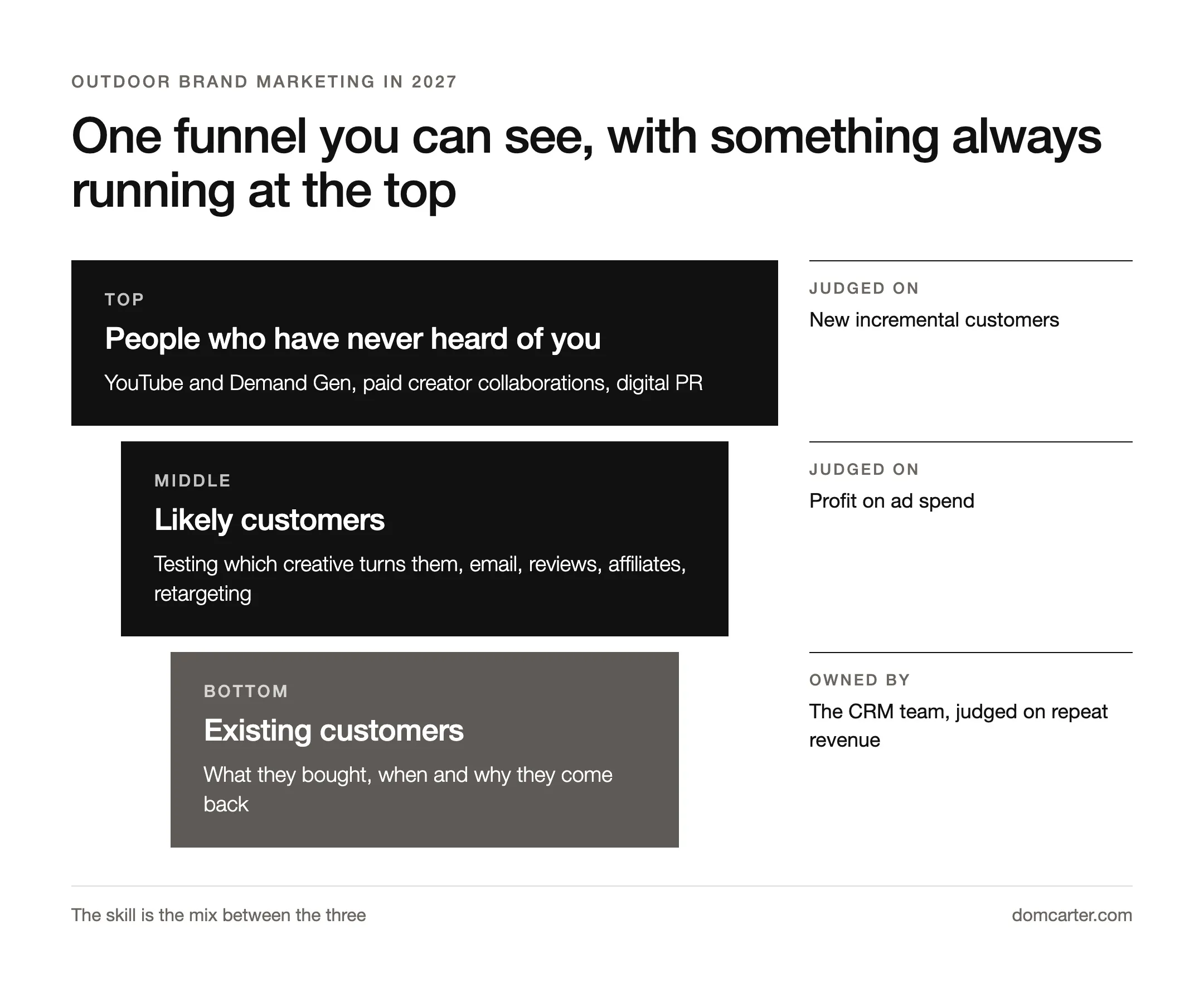
At the bottom are your existing customers. This is where you have the clearest view, because you know what they bought, when and for how much. It tells you which products bring people back, and what a good customer looks like.
In the middle are the likely customers. They’ve watched a video, visited the site or signed up for email, but haven’t bought yet. The question here is which creative turns them, and that’s what the extra content is for. You test different products, messages and formats on these people, and keep what moves them. I wrote about doing exactly this with paid social in paid media as a creative test lab.
At the top are people who have never heard of you. Something should be introducing your brand to new people all the time, not only around launches and sales. This is where YouTube and Demand Gen earn their place. They find people by what they watch and care about, before they ever search for a product.
The skill is in the mix between the three. Put too much into the bottom and you keep selling to the same people, which looks efficient right up until growth stops. Too much at the top, and you’re paying to be seen by people you never follow up with. Most brands I see are too heavy at the bottom, because that’s where the numbers look best.
Is content marketing enough on its own?
Content is enough, but only up to a point. There’s a ceiling, and most brands can feel it when they hit it. The content is still good and still going out. But growth flattens, because you’re reaching the same kind of people over and over.
At that point you need other people’s audiences. There are three ways to get them, and timing matters with each.
Paid creator collaborations come first for most outdoor brands. A creator who actually uses the kit, filmed in the places your customers go, reaches people your own channels never will. Choose them for how well their life matches your customer, not for follower count.
Digital PR comes next. It gets the brand into the sites your customers already read. It also earns links that help your own site rank in search. It works best once you have a story to tell, such as a launch, a result or something genuinely new about the product.
Affiliates come once there’s demand to capture. Review sites, comparison guides and specialist retailers send people who are already deciding what to buy. Switch them on too early and you’re paying commission on a brand nobody is searching for yet.
None of these replaces your own content. They multiply it, and the creator material in particular becomes more content you can run through the funnel.
Should outdoor brands pay for their own brand name in Google?
My view is that usually you shouldn’t. If people are searching for your brand by name, you should already be first in the normal Google results for it. An ad above that result mostly buys a click you’d have got for free, and a sale you’d have made anyway.
Swiss Side is a good example. Around a third of their Google budget was going on ads for people already searching for them by name. We cut that back and moved the money into searches from riders who hadn’t picked a brand yet. The result is on my brands page. Non-brand search beat its forecast by 39% on 14% less spend than planned. More of their sales now come from people who had never bought from them before.
There’s one time you should pay for your brand name, and that’s when a competitor is bidding on it. If someone else’s ad appears above your own listing, you need to protect it. That means paying. Even then, there are ways to defend the name more cheaply over time. It’s also worth checking regularly whether the competitor is still there.
How do you market a high-ticket product people won’t buy on impulse?
Nobody buys a £5,000 bike or a technical shell jacket on a whim. They research it for weeks or months, compare it with two or three alternatives, and look for reassurance that it’s worth the money. Your marketing has to be there through all of that, not only at the moment they’re ready to pay.
That means seeding. The reasons to buy need to reach people many times, over a long period and in different places. A YouTube video explains the design. An email shows it in use. A retargeting ad reminds them of the one feature they cared about. No single piece does the job. It’s the build-up that does.
For 2026 and 2027, I think one thing matters most for high-ticket kit. Get creators and reviewers to use the product and talk about it. Someone about to spend serious money looks for an independent opinion. Most of the time, that means a YouTube review. If your product isn’t in those reviews, someone else’s is. So send it to the people your buyers trust and let them be honest. Then use that content across the rest of the funnel.
How do you choose which countries to sell into?
Start with your margin, not the market size. The cost of the goods and of getting them to the customer decide whether a country is worth it.
Photo: AgainErick, CC BY-SA 4.0, via Wikimedia Commons.

The US is the obvious example. It’s a big market for outdoor kit and it’s tempting to go after it early. But say shipping, duties and returns take an extra 20% off your margin on every order there. You’d need far more sales to make the same profit. You can spend heavily on marketing in a country like that and still lose money on every customer it brings in.
So build locally first. Grow where delivery is cheapest and your margin is healthiest, and prove the model there. Then expand to the countries that are next cheapest to serve. When you do expand, judge each country on profit per order rather than revenue. Move budget towards the ones that are actually paying back.
What should an outdoor brand measure?
New customers matter, and I’d always track them. But the bottom line for marketing should be a combination of two things.
The first is profit on ad spend, often written POAS. Most brands still judge ads on return on ad spend, which is revenue divided by cost. Revenue hides a lot. It doesn’t know whether the sale was a full-price jacket or a discounted one, or whether it cost £5 or £50 to deliver. Profit on ad spend takes those costs out, so you can see which campaigns actually make the business money.
The second is new incremental customers. These are people who bought because of the marketing and wouldn’t have otherwise. That’s the real measure of whether the content, the creators and the Demand Gen budget are doing their job.
Revenue from existing customers is just as important, but I’d give it to a different team. The CRM team should own repeat revenue, through email, loyalty and everything that brings people back. If marketing is judged on that too, it takes credit for sales that would have happened anyway. The case for spending on new customers then gets weaker every month.
| The usual advice | What I’d do instead |
|---|---|
| Make less content and repurpose one story everywhere | Make more content, especially video, and keep one story at its core |
| Be present on every platform | Build one funnel you can see, from existing customers to strangers |
| Content marketing will carry you | Content gets you to a ceiling, then creators, digital PR and affiliates take over |
| Always bid on your own brand name | Only bid on it when a competitor is taking the space |
| Go after the biggest markets first | Build where your margin is healthiest, then expand |
| Judge marketing on revenue and return on ad spend | Judge it on profit on ad spend and new incremental customers |
Where to start
If you run marketing for an outdoor brand, start with two numbers. Find out what share of your Google budget goes on your own brand name, and how many of last year’s customers were new. If the first is high and the second is low, you’re paying to sell to people who already know you.
Every month that carries on, the bigger brands are using YouTube and creators to introduce themselves to the customers you’ll need next year.
Questions people ask
- What is the best marketing strategy for an outdoor brand in 2027?
- Make more content, mostly video, and push it through YouTube and Google's Demand Gen campaigns. Join every channel into one funnel so you can see existing customers, likely customers and people who have never heard of you. Keep something running at the top all the time, and judge it on profit and new customers rather than revenue.
- Should outdoor brands use YouTube and Demand Gen?
- Yes, and they should be making the content to feed them. Google is pushing more advertiser budget towards Demand Gen, which runs video and image ads across YouTube, Shorts, Discover and Gmail. It finds people before they search, which suits outdoor brands with a story to show. It only works well with a steady supply of fresh video.
- When should an outdoor brand start working with creators and affiliates?
- When your own content stops bringing in new kinds of customer. Growth flattens even though the content is still going out. Paid creator collaborations come first, chosen for how well they match your customer. Digital PR follows once you have a story to tell. Affiliates come last, once people are searching for the brand and there is demand to capture.
- Should an outdoor brand pay for ads on its own brand name?
- Usually not. If your brand is strong enough to be searched, you should already be first in the normal results, and paying for that click buys sales you'd have made anyway. The exception is when a competitor bids on your name and appears above you. Then you pay to protect it, and look for ways to make that cheaper over time.
- How do you sell an expensive bike or piece of outdoor kit online?
- Slowly and in lots of places. People don't buy high-ticket kit on impulse, so the reasons to buy need to reach them over months through YouTube, email and other channels. The biggest lever now is getting creators and reviewers to use the product and talk about it honestly, because that is where these buyers go to check.
- What should an outdoor brand measure in its marketing?
- Profit on ad spend, which takes the cost of the product and delivery out of the return, and the number of new customers who bought because of the marketing. Repeat revenue from existing customers matters too, but that belongs to the CRM team. Mixing the two lets marketing take credit for sales that would have happened anyway.